No memorizing charts. No flashcards. No subscription.
Just open your browser, read the key signature question and answer – on the train, during your break, wherever you want.
The free Circle of Fifths exercise on theorie-musik.de trains your knowledge of the key signatures of all major and minor keys – fast, interactive and at your own pace. With 10 progressive levels, the exercise is ideal for everyone preparing for exams, music theory grades or conservatory entrance tests.
Knowing the circle of fifths by heart is no magic trick – but it takes practice. That’s exactly what this tool is for.
What Does This Exercise Train?
You see a key and have to state how many accidentals it has – and whether they are sharps (♯) or flats (♭). The exercise trains:
- the key signatures of all major keys – from C major (no accidentals) to C♯ major (7 sharps) and C♭ major (7 flats)
- the key signatures of all minor keys – from A minor (no accidentals) to A♯ minor and A♭ minor
- the quick recall of key → accidentals, as required in exams
- the mixed questioning of major and minor in the second highest level
- the mixed questioning including identification of the relative key
Who Is the Exercise Suitable For?
- Music theory grade candidates – targeted preparation for written exams
- Music students & A-level students – for exams and entrance tests
- Instrumental students – who want to know keys and accidentals confidently
- Hobby musicians & advanced learners – who want to systematically deepen their theory knowledge
- Music teachers – for revision and consolidation of circle of fifths knowledge
The 10 Levels at a Glance
Levels 1–4: Major Keys
🟢 Level 1
Major keys with up to 2 accidentals
🟡 Level 2
Major keys with up to 4 accidentals
🟡 Level 3
Major keys with up to 6 accidentals
🔴 Level 4
All major keys (up to 7 accidentals)
Levels 5–8: Minor Keys
🟢 Level 5
Minor keys with up to 2 accidentals
🟡 Level 6
Minor keys with up to 4 accidentals
🟡 Level 7
Minor keys with up to 6 accidentals
🔴 Level 8
All minor keys (up to 7 accidentals)
Levels 9 & 10: The Full Challenge
🔴 Level 9
All major and minor keys mixed
🔴 Level 10
All major and minor keys mixed – including identification of the relative key
💡 Exam tip: Work your way through from Level 1 to Level 10 – anyone who masters Level 10 confidently is well prepared for any exam or music theory grade!
How the Exercise Works – Step by Step
1. Choose a Level
Select one of the 10 levels shown in the overview.
2. Answer the Multiple Choice Question
Answer the displayed question using the buttons – the exercise is a multiple choice quiz.
3. Next Question
If your answer was correct, the button lights up green. If it was wrong, it lights up red and the correct answer – one of the other three buttons – lights up green at the same time. The next question appears automatically.
✅ Correct → you earn a point
❌ Wrong → one life is deducted
Circle of Fifths – Reference Table for Exams
Major Keys
| Accidentals | Key |
|---|---|
| none | C major |
| 1 sharp | G major |
| 2 sharps | D major |
| 3 sharps | A major |
| 4 sharps | E major |
| 5 sharps | B major |
| 6 sharps | F♯ major |
| 7 sharps | C♯ major |
| 1 flat | F major |
| 2 flats | B♭ major |
| 3 flats | E♭ major |
| 4 flats | A♭ major |
| 5 flats | D♭ major |
| 6 flats | G♭ major |
| 7 flats | C♭ major |
Minor Keys and Their Key Signatures
Every minor key shares its key signature with its relative major key –
the relative major always lies a minor third above the minor key.
| Accidentals | Minor Key | Relative Major |
|---|---|---|
| none | A minor | C major |
| 1 sharp | E minor | G major |
| 2 sharps | B minor | D major |
| 3 sharps | F♯ minor | A major |
| 4 sharps | C♯ minor | E major |
| 5 sharps | G♯ minor | B major |
| 6 sharps | D♯ minor | F♯ major |
| 7 sharps | A♯ minor | C♯ major |
| 1 flat | D minor | F major |
| 2 flats | G minor | B♭ major |
| 3 flats | C minor | E♭ major |
| 4 flats | F minor | A♭ major |
| 5 flats | B♭ minor | D♭ major |
| 6 flats | E♭ minor | G♭ major |
| 7 flats | A♭ minor | C♭ major |
More Exercises on theorie-musik.de
- Interval Writing – Notate intervals correctly and add accidentals
- Interval Reading – Recognize and name intervals
- Note (Affiliate-Link)¹ Reading in Treble Clef – Learn to read the G clef confidently
- Note (Affiliate-Link)¹ Reading in Bass Clef – Learn to read the F clef confidently
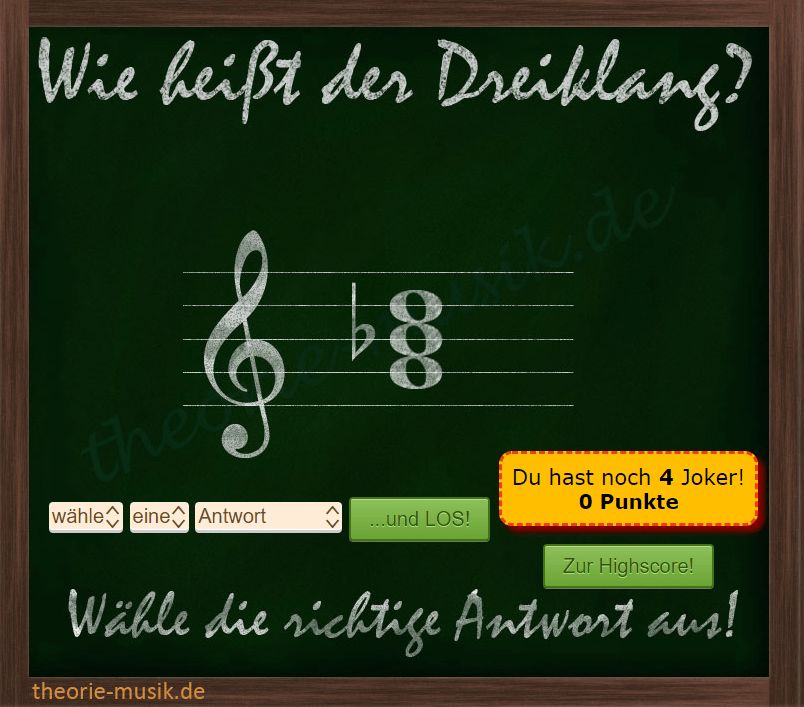
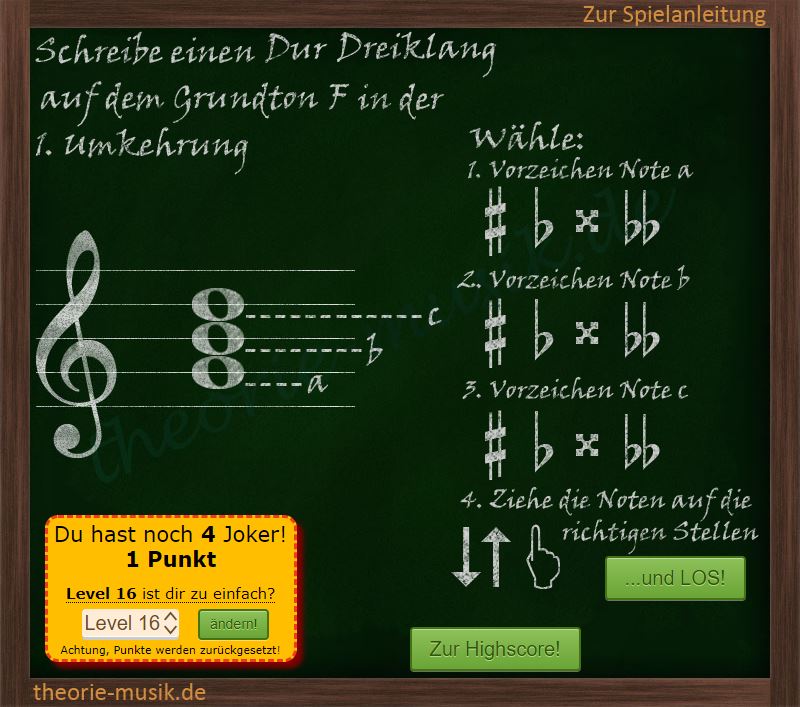
- Chord Reading – Recognize triads and their inversions confidently
Frequently Asked Questions (FAQ)
What is the circle of fifths?
The circle of fifths is a circular arrangement of all major and minor keys, ordered by the number of their accidentals. Moving clockwise, each step adds one sharp; moving counterclockwise, each step adds one flat. It is a central tool of music theory and helps to quickly recognize keys, accidentals and harmonic relationships.
What are relative keys?
Every major key has a relative minor key with the same key signature. The relative minor always lies a minor third below the major key: C major and A minor, for example, both have no accidentals; G major and E minor both have 1 sharp. You can practice this in Level 10.
Which keys are tested?
Depending on the chosen level, major keys (Levels 1–4), minor keys (Levels 5–8) or both mixed (Levels 9 & 10) are tested – with up to 7 sharps or 7 flats as accidentals.
Which exams is the exercise suitable for?
The exercise is particularly suitable for music theory grade exams, conservatory exams, entrance tests and music A-levels.
Is the exercise free?
Yes – completely free, without registration and without any app download. Just start in your browser.
Can I use the exercise on my smartphone?
Yes, the exercise is fully optimized for mobile devices and works on smartphones and tablets without installation.
Kostenlose online Übungen
Interaktiver Karussell mit 6 Musiktheorie-Übungen. Nutze die Pfeiltasten oder wische, um zwischen den Übungen zu navigieren.
Quintenzirkel lernen
Lerne den Quintenzirkel und die Zusammenhänge zwischen Tonarten und Vorzeichen.