No paper. No pencil. No subscription.
Just grab your phone, listen to or read an interval and answer – on the train, during your break, wherever you want.
The free Interval Trainer on theorie-musik.de is an interactive online exercise for music students, conservatory students and everyone who wants to improve their musical ear and music theory skills. See an interval on the staff, hear it, or write it yourself – that’s how easy interval training online works!
The exercise is suitable for both beginners and advanced music theory learners. With 10 levels, three practice modes (Reading, Writing, Listening), a highscore system and a flexible Custom Mode, practicing stays varied and motivating.
You don’t learn to recognize intervals by reading about them – you learn by doing. That’s exactly what this tool is for.
You see or hear an interval, choose the correct answer or drag the second note (Affiliate-Link)¹ to the right position – and get instant feedback. Done. No installation, no registration, no subscription – just start practicing.
What Is a Musical Interval?
An interval is the distance between two pitches. Recognizing and naming intervals is one of the most important foundations of music theory and ear training. Those who master intervals read sheet music faster, hear melodies more precisely and understand harmony more deeply.
Who Is the Interval Trainer For?
The Interval Trainer on theorie-musik.de is designed for:
- Music students – ideal preparation for lessons or exams
- Grade exam candidates – perfect preparation for music theory grade exams
- Conservatory students – ear training for entrance exams and tests
- Music A-level students – preparation for music exams
- Hobby musicians – improve your ear and interval recognition
- Music teachers – as a supplement in lessons
From beginner to expert – with 10 levels and three practice modes, there’s something for every skill level.
And it never gets boring – the possible combinations of intervals, directions and sound types are so varied that hardly any question is the same as the last. Every round brings a new challenge!
The 3 Practice Modes
👁️ Reading
You see two notes on the staff and choose the correct interval from four answer options. Ideal for beginners and for training note (Affiliate-Link)¹ reading skills.
✏️ Writing
You see the first note (Affiliate-Link)¹ and drag the second note to the correct position on the staff. This trains not only recognition but also the notation of intervals.
🎧 Listening
You hear an interval – melodically (one after the other) or harmonically (simultaneously) – and choose the correct answer. The notes are only revealed after your answer. This is real ear training!
The 10 Levels at a Glance
The levels are divided into three groups based on practice mode and difficulty:
👁️ Reading Only (Levels 1–4)
Level 1 – Unison to Fifth · Recognizing basic intervals
Perfect, minor and major intervals from the unison to the fifth. Ideal for beginners.
Level 2 – Unison to Octave · More intervals
All basic intervals up to the octave – minor, major and perfect intervals.
Level 3 – Unison to Octave · + Diminished & Augmented
Like Level 2, but now diminished and augmented intervals are added.
Level 4 – Unison to Tenth · + Diminished & Augmented
The full spectrum up to the tenth – all interval types in reading mode.
✏️ Reading & Writing (Levels 5–7)
Level 5 – Unison to Fifth · Place note (Affiliate-Link)¹ by dragging
Now it’s time to write! Drag the second note to the correct position – basic intervals up to the fifth.
Level 6 – Unison to Octave · + Diminished & Augmented
Reading and writing up to the octave, including diminished and augmented intervals.
Level 7 – Unison to Tenth · + Diminished & Augmented
The full spectrum up to the tenth in combined reading and writing mode.
🎧 Reading, Writing & Listening (Levels 8–10)
Level 8 – Unison to Fifth · Identifying intervals by ear
Now the ear gets involved! All three modes – reading, writing and listening – with basic intervals up to the fifth.
Level 9 – Unison to Octave · + Diminished & Augmented
All modes up to the octave, including diminished and augmented intervals.
Level 10 – Unison to Tenth · All interval types
The ultimate level: all intervals up to the tenth, all qualities, all modes. For true experts only! 🏆
⚙️ Custom Mode – Your Own Training
Those who want to practice even more specifically can configure their own training in Custom Mode:
- Intervals – Choose exactly the interval degrees you want to practice: from the unison to the tenth
- Interval type – With or without diminished & augmented intervals
- Practice modes – Reading, writing and/or listening – combine as you like
- Direction – Ascending, descending or both
- Sound – Melodic (one after the other) or harmonic (simultaneously)
Custom Mode is especially useful for working on specific weaknesses – for example, practicing only sevenths, or training the listening mode with simple intervals. No highscore, but maximum freedom!
How the Interval Trainer Works – Step by Step
1. Choose a Level
Select one of the 10 levels or Custom Mode at the start. The training begins immediately – no registration required.
2. Practice Mode
Depending on the level, the trainer automatically switches between reading, writing and listening. The current mode is shown as a badge at the top of the game.
3. Recognize or Enter the Interval
Reading: Look at the two notes on the staff and click on the correct answer from the four options.
Writing: Drag the second note (Affiliate-Link)¹ to the correct position on the staff using drag & drop, then click ✔ Check.
Listening: Click 🔊 Play Interval and then choose the correct answer. The notes are only revealed after your answer.
4. Get Feedback
After each answer you immediately see whether you were right or wrong. A correct answer earns you points, a wrong answer costs you a life ❤️.
5. Next Question
After each answer the button ➡️ Next Question appears – so you continue at your own pace.
6. Finish & Highscore
Click ✕ Quit to end the training and enter your name in the highscore list.
Points & Lives System
You start with 4 lives ❤️❤️❤️❤️. Each wrong answer costs one life. When all lives are gone, the Game Over screen appears with:
- your final score
- an overview of your interval accuracy
- the option to enter your name in the highscore list
- the button 🔄 Play Again
How Are Points Calculated?
Points depend on the level and the practice mode:
- Writing gives the most points (it’s harder!)
- Listening gives more points than reading
- Higher levels = more points per correct answer
Which Intervals Are Included?
Depending on the level and settings, the following intervals appear:
Unison
Perfect Unison, Augmented Unison
Second
Minor, Major, Augmented Second
Third
Diminished, Minor, Major, Augmented Third
Fourth
Diminished, Perfect, Augmented Fourth
Fifth
Diminished, Perfect, Augmented Fifth
Interval Trainer on Smartphone & Tablet
The Interval Trainer works fully on mobile devices. The drag & drop in writing mode is optimized for touch – simply drag the note (Affiliate-Link)¹ to the correct position with your finger.
More Exercises on theorie-musik.de
Those who want to further improve their ear and music theory skills will find more free exercises on theorie-musik.de, for example:
- Rhythm Dictation – Hear rhythms and enter them as notes
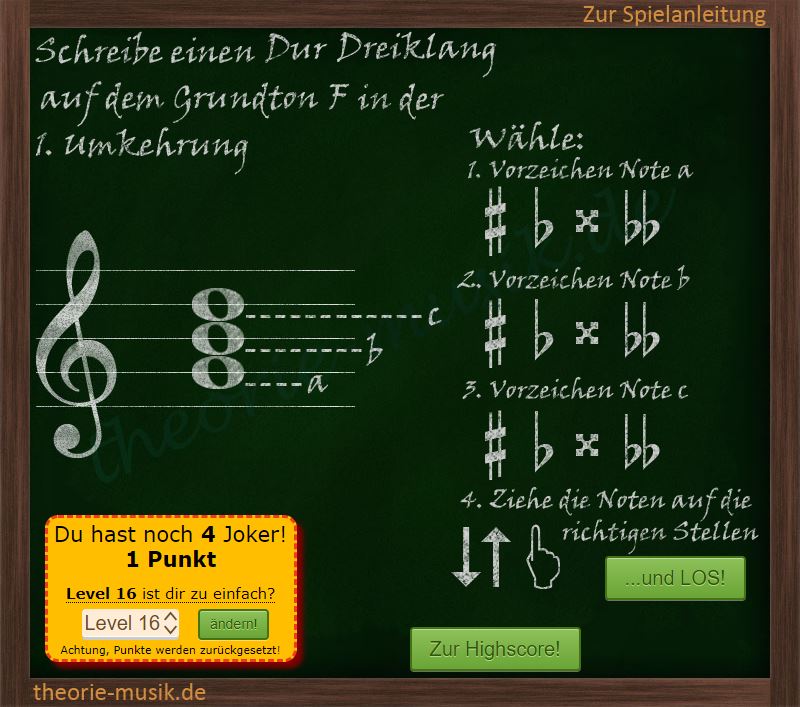
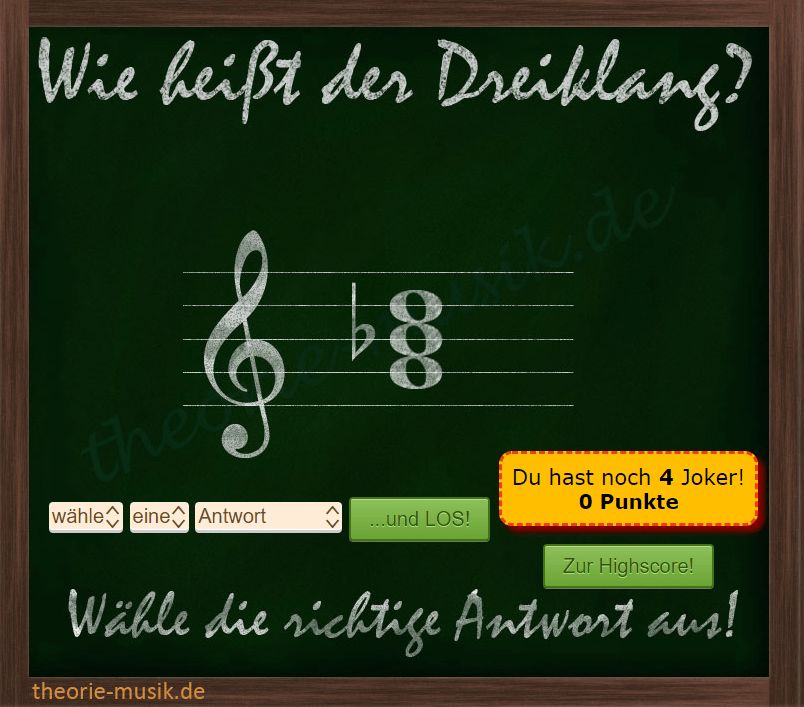
- Chord Writing – Major, minor, diminished and augmented triads
- Note (Affiliate-Link)¹ Writing – Practice writing notes correctly
- Circle of Fifths – Train key signatures and tonalities
Frequently Asked Questions (FAQ)
What is a musical interval?
An interval is the distance between two pitches. There are perfect, minor, major, diminished and augmented intervals – from the unison to the tenth and beyond.
Who is the Interval Trainer suitable for?
The exercise is suitable for music students, conservatory students, music teachers and everyone who wants to improve their ear and music theory – from beginner to expert.
Is the Interval Trainer free?
Yes! The Interval Trainer on theorie-musik.de is completely free and usable without registration.
What is the difference between melodic and harmonic?
With melodic sound, the two notes are played one after the other. With harmonic sound, both notes sound simultaneously – this is more challenging for the ear.
What is Custom Mode?
In Custom Mode you can set intervals, interval types, practice modes, direction and sound yourself and practice specific intervals in a targeted way – without any score pressure or life limit.
Can I use the Interval Trainer on my phone?
Yes, the exercise is fully optimized for mobile devices and works on smartphones and tablets – including touch drag for writing mode.
Why are diminished and augmented intervals not included in listening mode?
Diminished and augmented intervals sound identical to other intervals (e.g. an augmented unison sounds like a minor second). In listening mode, only intervals that are clearly distinguishable by ear are therefore included.
Kostenlose online Übungen
Interaktiver Karussell mit 6 Musiktheorie-Übungen. Nutze die Pfeiltasten oder wische, um zwischen den Übungen zu navigieren.
Intervalle Trainer
Trainiere das korrekte Notieren und Lesen von Intervallen – von der Sekunde bis zur Oktave.