A scale has 8 notes, where the 1st and 8th notes are always the same, just an octave higher. To be able to consistently maintain these steps starting from any note, we need accidentals in almost every scale except C major and A minor.
A scale is divided into 8 degrees (8 notes) to describe it more precisely. A distinction is also made between major and minor scales. Major scales sound ‘happy’, minor scales ‘sad’. Both have their own character.
Major scale
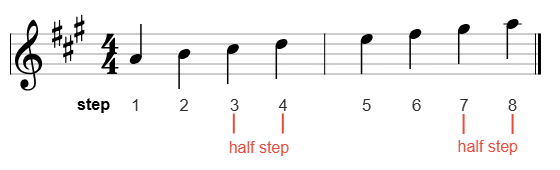
The major scale has a half step (minor second) between the 3rd and 4th degrees and between the 7th and 8th degrees. A major scale always has a relative minor scale, which is found a minor third lower, starting from the root note.
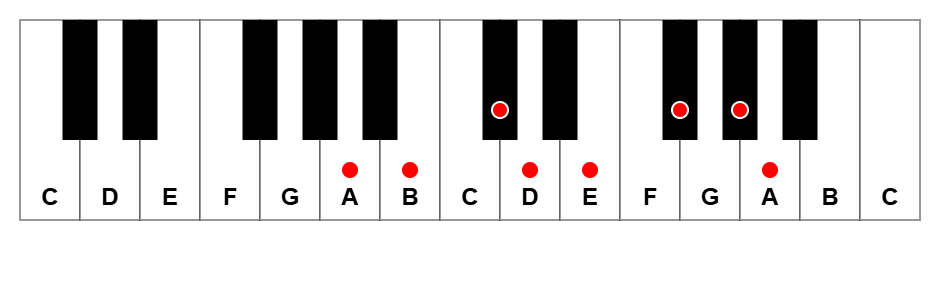
Piano keyboard with 2 octaves. The keys are labeled with note names. 8 keys are marked: A in octave 1, B in octave 1, C# in octave 2, D in octave 2, E in octave 2, F# in octave 2, G# in octave 2, A in octave 2.
A major on the keyboard
Minor scale
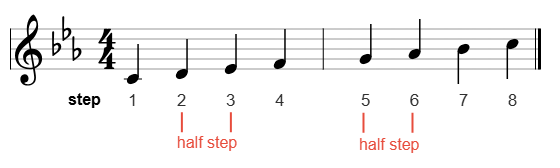
The minor scale has a half step (minor second) between the 2nd and 3rd scale degrees and between the 5th and 6th scale degrees. A minor scale always has a relative major scale, which is found a minor third higher, starting from the root. In addition, there are melodic and harmonic minor scales.
C minor – treble clef. Musical notation consisting of 8 notes. Clef: treble clef. Time signature: 4/4. Notes used: C4 (quarter note), D4 (quarter note), Eb4 (quarter note), F4 (quarter note), G4 (quarter note), Ab4 (quarter note), Bb4 (quarter note), and C5 (quarter note). The half-step intervals between scale degrees 2 and 3—specifically between D and Eb—and between 5 and 6—specifically between G and Ab—are highlighted.
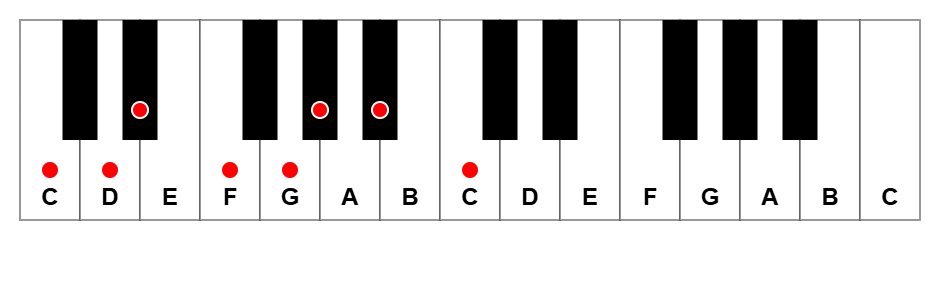
C minor scale on the keyboard
Piano keyboard with 2 octaves. The keys are labeled with note names. 8 keys are marked: C in octave 1, D in octave 1, D# in octave 1, F in octave 1, G in octave 1, G# in octave 1, A# in octave 1, C in octave 2.
C minor scale on the keyboard
The keyboard as a memory aid
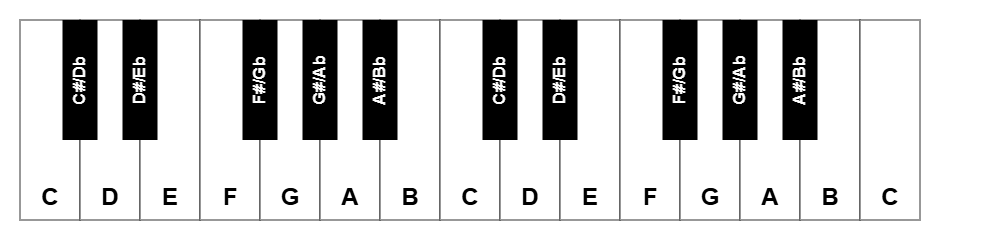
If we look at a keyboard, it is quite easy to remember the intervals:
Piano keyboard with 2 octaves. The keys are labeled with note names, black keys additionally with enharmonic names: C#/Db, D#/Eb, F#/Gb, G#/Ab and A#/Bb. No keys are marked.
Keyboard (piano)
If you play a C major scale, no black keys are needed, just as with the A minor scale.
The distance to the next key, whether white or black, is always a half step. So, the distance from the white key E to the white key F and the distance between the white key B and the white key C are each a half step. The distance from the white key C to the white key D goes across a black key, so here we have two half steps -> the distance is a whole step.
If you count the keys starting from C in the C major scale, we get the half step from key 3 to 4 and 7 to 8: half steps between degree 3 (E) and 4 (F) and between degree 7 (B) and 8 (C).
Likewise for the A minor scale: B to C, scale degrees 2 to 3, and E to F, scale degrees 5 and 6.
All Minor and Major Scales with Sharps
All Minor and Major Scales with Flats
C major A minor (0 sharps) G major – E minor (1 sharp) D major – B minor (2 sharps) A major – F-sharp minor (3 sharps) E major – C-sharp minor (4 sharps) B major – G-sharp minor (5 sharps) F-sharp major – D-sharp minor (6 sharps)
C major – A minor (0 flats) F major – D minor (1 flat) B-flat major – G minor (2 flats) E-flat major – C minor (3 flats) A-flat major – F minor (4 flats) D-flat major – B-flat minor (5 flats) G-flat major – E-flat minor (6 flats)
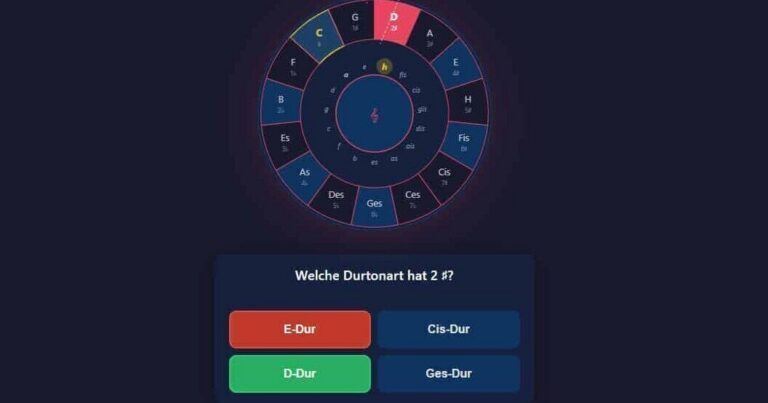
Free Online Exercises
Interactive carousel with 5 music theory exercises. Use the arrow keys or swipe to move between the exercises.