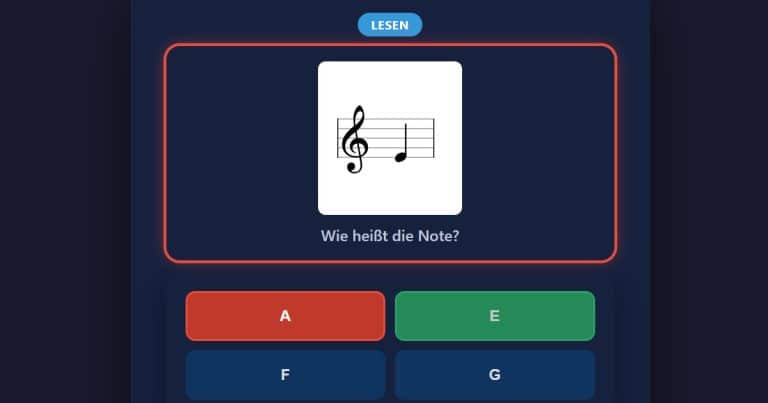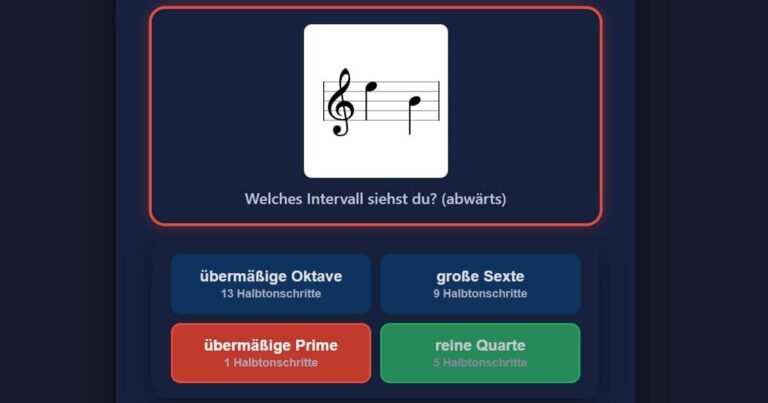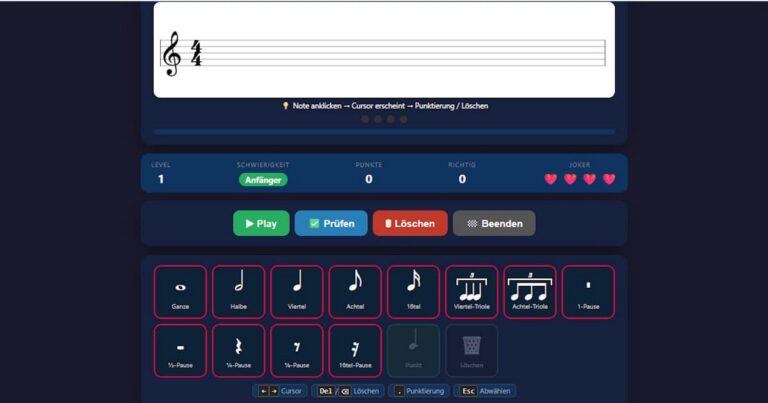
No paper. No pencil. No subscription.
Just grab your phone, see, write and hear chords – on the train, during a break, wherever you like.
The free Chord Trainer on theorie-musik.de is an interactive online exercise for music students, university students and anyone who wants to improve their ear and their knowledge of harmony. See a chord on the staff, write it yourself, or listen to it and work out what you hear – that is how simple online chord training works!
The exercise suits beginners as well as advanced music theory learners. With 12 levels, three exercise modes (reading, writing, listening), a highscore system and a flexible custom mode, practising stays varied and motivating. And the best part: the start is deliberately gentle. The first levels use major chords only; minor, inversions, accidentals and seventh chords are added step by step.
You don’t learn to recognise chords by reading about them – you learn by practising. That is exactly what this tool is for.
You see or hear a chord, choose the right answer or place the notes on the staff yourself – and get instant feedback. That’s it. No installation, no sign-up, no subscription – just start.
What is a chord?
A chord is a combination of at least three notes stacked in thirds. Recognising and naming chords is one of the most important foundations of harmony. If you know your chords well, you read notes faster, hear harmony more precisely and understand how music is built.
The trainer works with these chord types:
- Major – triad made of a major third and a minor third
- Minor – triad made of a minor third and a major third
- Diminished – two minor thirds stacked
- Augmented – two major thirds stacked
- Dominant seventh – major triad with an added minor seventh
Every chord can be in root position or in an inversion. Triads have a 1st inversion (sixth chord) and a 2nd inversion (six-four chord). The dominant seventh adds a 3rd inversion (four-two chord).
Who is the Chord Trainer for?
The Chord Trainer on theorie-musik.de is aimed at:
- Music school students – ideal for preparing for lessons or exams
- Conservatory students – ear training and harmony for entrance exams and tests
- School students – preparation for music exams
- Hobby musicians – improve your feeling for chords and your ear in a targeted way
- Music teachers – as a supplement to lessons
From beginner to expert – with 12 levels and three exercise modes, there is something for every stage.
And it will never get boring – the possible chords, root notes, positions and accidentals are so varied that hardly any two questions are alike. Every round brings a new challenge!
The 3 exercise modes
👁️ Reading
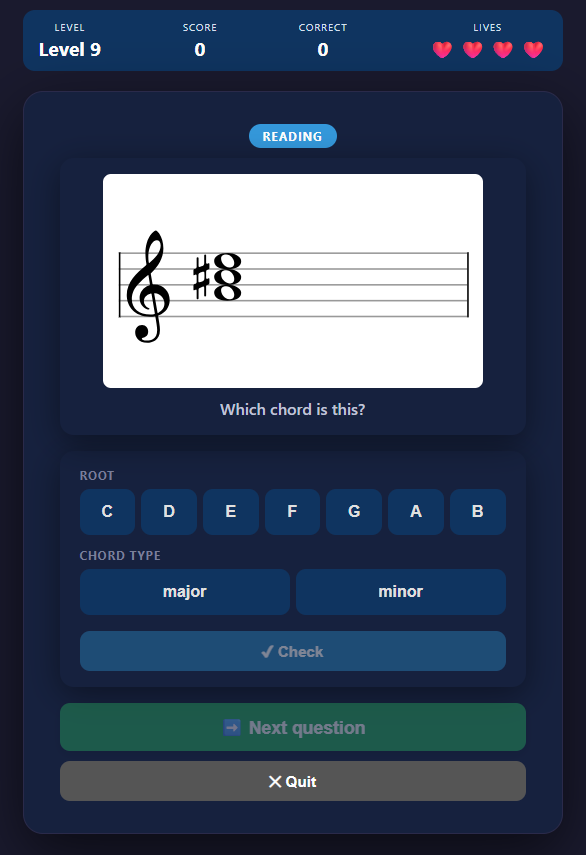
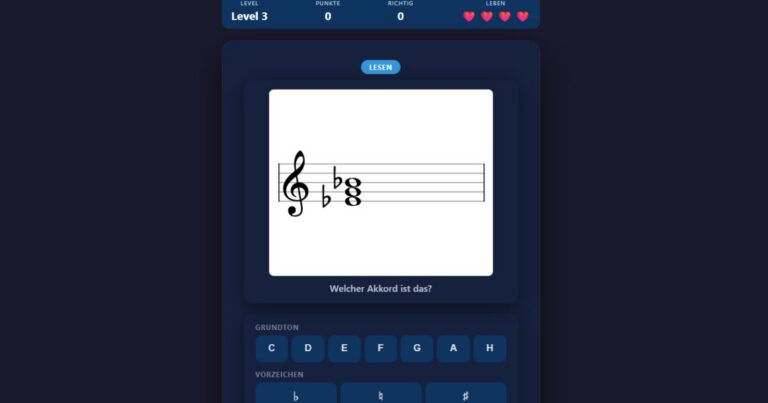
You see a chord on the staff and identify it in up to four steps: root, accidental, chord type and position. Which rows of choices you see depends on the level – in the first levels there are only a few. If only one row is left (for example just the root in level 1), your answer is checked immediately; otherwise you confirm with ✔ Check. After answering you can see which parts were right and which were wrong.
✏️ Writing
You are given a chord, for example “F♯ minor, 1st inversion”, and place the notes on the staff yourself:
- On a computer: Click on the staff with the mouse. A guide line shows you where the note (Affiliate-Link)¹ will land.
- On a phone: Put your finger on the staff and drag. The line shows the position, and the note (Affiliate-Link)¹ is placed when you lift your finger.
- Accidentals: The selected note (Affiliate-Link)¹ gets its accidental with the buttons ♭ ♮ ♯ (level 12 also offers 𝄫 and 𝄪).
- Correcting: 🗑 Remove note (Affiliate-Link)¹ deletes the selected note, ↺ Clear all starts over.
The octave doesn’t matter, but the spelling does: C♯ and D♭ are two different notes and cannot be swapped. After ✔ Check you see the correct solution.
🎧 Listening
You hear a chord. The root is shown on the staff; the other notes stay hidden until you have answered.
- Level 9: You decide whether you hear major or minor.
- From level 10: You also identify the position. For this the chord is played broken, from bottom to top. Listen for the lowest note (Affiliate-Link)¹: is it the root, the third or the fifth?
- From level 11: The dominant seventh is added.
This is real ear training!
The 12 levels at a glance
The levels are divided into three groups, which differ by exercise mode and difficulty:
👁️ Reading only (levels 1–5)
Level 1 – Major only · root position · no accidentals
The gentle start: major triads on the white keys, root position only.
Level 2 – Major only · + inversions · no accidentals
Now the major triads also appear in 1st and 2nd inversion.
Level 3 – Major & minor · root position · no accidentals
Minor joins in. You tell major and minor apart in root position.
Level 4 – Major & minor · + inversions · no accidentals
Major and minor in all positions.
Level 5 – Major & minor · inversions · with accidentals
Now with ♯ and ♭ as well: roots like F♯, B♭ or E♭.
✏️ Reading & writing (levels 6–8)
Level 6 – Major only · root position · place the notes
Now you write! Place the notes of a major triad on the staff yourself.
Level 7 – Major & minor · inversions · with accidentals
Reading and writing with major and minor in all positions and with accidentals.
Level 8 – + Diminished & augmented · inversions
Diminished and augmented triads join major and minor.
🎧 Reading, writing & listening (levels 9–12)
Level 9 – Major & minor · root position · identify by ear
Now your ear comes into play! All three modes, with major and minor in root position and without accidentals.
Level 10 – Major & minor · hear the inversions too · with accidentals
When listening you identify not only major or minor, but also the position.
Level 11 – + Dominant seventh · all inversions
The dominant seventh in root position, six-five, four-three and four-two chord.
Level 12 – All chords · inversions · incl. double accidentals
The ultimate level: all chord types, all positions, all modes, including double accidentals. For true experts only! 🏆
⚙️ Custom mode – your own training
If you want to practise even more precisely, you can configure the training exactly as you like in custom mode:
- Chord types – major, minor, diminished, augmented and dominant seventh, in any combination
- Positions – root position, 1st, 2nd and (for the dominant seventh only) 3rd inversion
- Root note (Affiliate-Link)¹ – without accidentals, with ♯/♭, or both
- Exercise modes – reading, writing and/or listening – in any combination
- Sound (listening) – together or broken. If the position is also asked while listening, the chord is always played broken, because otherwise you could not hear the position.
Custom mode is especially good for working on weak spots – for example practising only inversions of major triads, or training the listening mode with dominant sevenths. No highscore, but maximum freedom!
How the Chord Trainer works – step by step
1. Choose clef and level
At the start, choose the treble or bass clef and then one of the 12 levels or custom mode. The training starts immediately – no sign-up needed.
2. Exercise mode
Depending on the level, the trainer switches automatically between reading, writing and listening. The current mode is shown as a badge at the top of the game.
3. Identify or write the chord
Reading: Look at the chord, choose root, accidental, chord type and position, and click ✔ Check.
Writing: Place the notes of the named chord on the staff, choose accidentals if needed, and click ✔ Check.
Listening: Click 🔊 Play chord and then choose the right answer. You can listen to the chord as often as you like. After your answer the chord is revealed on the staff.
4. Get feedback
After every answer you immediately see whether you were right or wrong, and below it the correct solution, for example “F♯ minor, 1st inversion”. A correct answer earns points, a wrong one costs a life ❤️.
5. Next question
After every answer the ➡️ Next question button appears – so you move on at your own pace.
6. End the game & highscore
With ✕ Quit you finish the training and can enter yourself in the highscore list of your level.
Points & lives
You start with 4 lives ❤️❤️❤️❤️. Every wrong answer costs one life. When all lives are gone, the game-over screen appears with:
- your final score
- an overview of your success rate per chord type
- the option to enter yourself in the highscore list
- the ↺ Play again button
How are points calculated?
Points depend on the level and on the exercise mode:
- Writing earns the most points (it’s harder!)
- Listening earns more points than reading
- Higher levels = more points per correct answer
Every level has its own top-20 list. There is no highscore in custom mode.
Which chords appear?
Depending on the level and settings, these chords appear on all root notes, with or without accidentals:
Triads: major, minor, diminished, augmented – each in root position (third and fifth above the root), 1st inversion (sixth chord) and 2nd inversion (six-four chord).
Dominant seventh: root position (seventh chord), 1st inversion (six-five chord), 2nd inversion (four-three chord) and 3rd inversion (four-two chord).
Chord Trainer on smartphone & tablet
The Chord Trainer works fully on mobile devices. The rows of choices in reading mode are kept compact for small screens, and in writing mode you place the notes with your finger: touch, drag, release. The guide line shows you where the note (Affiliate-Link)¹ will land.
More exercises on theorie-musik.de
If you want to improve your ear and your music theory further, you will find more free exercises on theorie-musik.de, for example:
- Interval Trainer – see, hear and write intervals
- Rhythm dictation – hear rhythms and enter them as notes
- Writing notes – practise writing notes correctly
- Circle of fifths – practise keys and key signatures
Frequently asked questions about the Chord Trainer (FAQ)
What is a chord?
A chord is a combination of at least three notes stacked in thirds. There are major, minor, diminished and augmented triads as well as the dominant seventh, each in root position and inversions.
What is an inversion?
In an inversion, a note (Affiliate-Link)¹ other than the root is in the bass. If the third is at the bottom, it is the 1st inversion (sixth chord); if the fifth is at the bottom, it is the 2nd inversion (six-four chord). With the dominant seventh, the seventh can also be at the bottom (3rd inversion, four-two chord).
Who is the Chord Trainer for?
The exercise suits music school students, conservatory students, music teachers and everyone who wants to improve their ear and their harmony skills – from beginner to expert.
Is the Chord Trainer free?
Yes! The Chord Trainer on theorie-musik.de is completely free and can be used without signing up.
Do I have to hit the right octave in writing mode?
No, the octave doesn’t matter. What counts is that the notes and the distances between them are right and that the spelling is correct: C♯ and D♭ are different notes.
Can you really hear inversions?
Yes, if you listen for the lowest note (Affiliate-Link)¹. That is why the chord sounds from bottom to top: first you hear the bass note on its own, then the other notes join in. Is the bass note the root, the third or the fifth? This is a classic ear training task, but it is more demanding than just telling major and minor apart. That is why it only appears from level 10.
Why are there no diminished and augmented chords in listening mode?
Diminished and augmented triads sound ambiguous. The augmented triad, for example, divides the octave into three equal parts, so the root and the position cannot be heard clearly. In listening mode, therefore, only major, minor and the dominant seventh are used.
What is custom mode?
In custom mode you set chord types, positions, root notes, exercise modes and sound yourself and can practise specific chords in a targeted way – without pressure for points or a limit on lives.
Can I use the Chord Trainer on my phone?
Yes, the exercise is fully optimised for mobile and works on smartphones and tablets – including touch control for writing mode.
Can I also practise in the bass clef?
Yes. On the start screen you can choose between treble and bass clef. The choice applies to all levels and is remembered.
Free Online Exercises
Interactive carousel with 4 music theory exercises. Use the arrow keys or swipe to move between the exercises.
Reading Chords and Triads
Identify chords and triads in sheet music and strengthen your understanding of harmony.