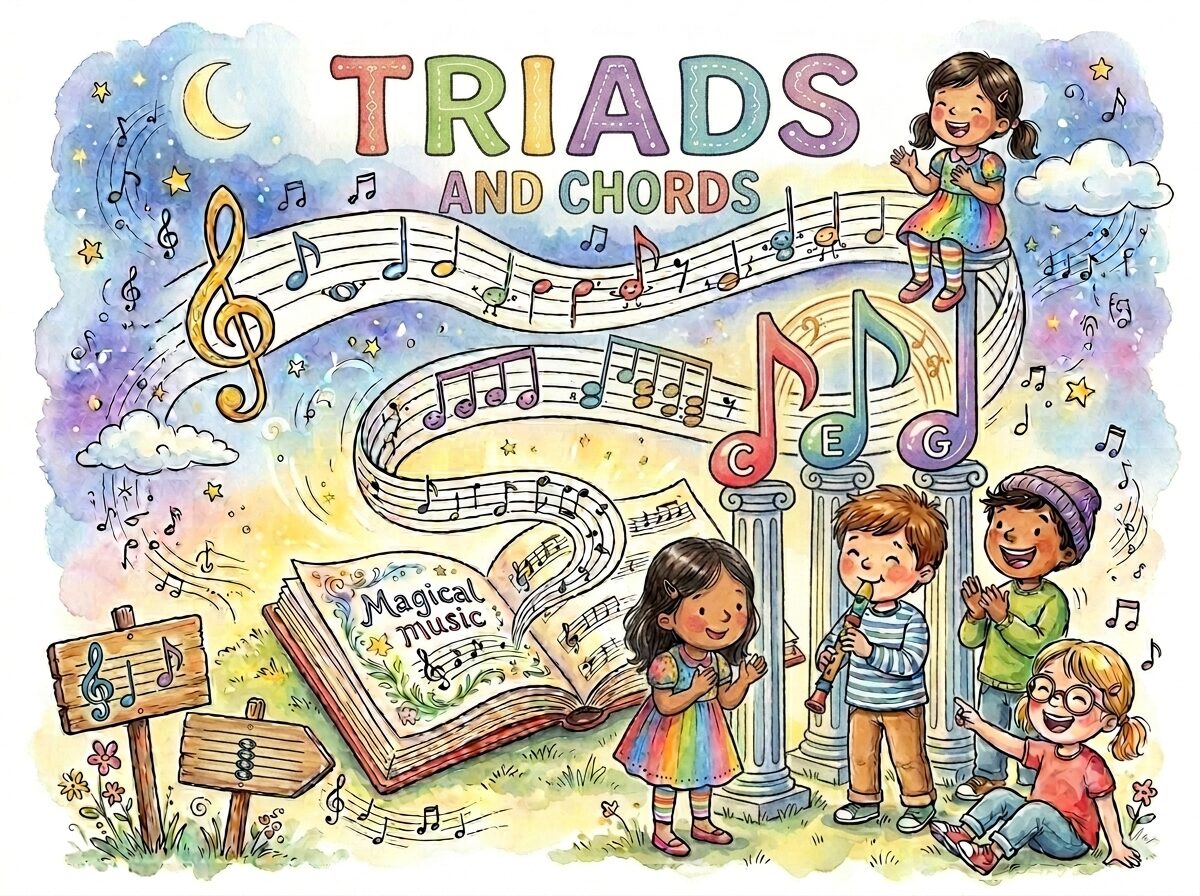
A chord is formed whenever at least three different notes simultaneously sound; two notes alone merely form an interval in music theory. In Western harmony, triads and seventh chords represent the most frequently used basic forms on which a large part of all musical compositions is built.
Polyphonic vs. Melodic Instruments
Interestingly, only relatively few instruments are technically capable of actually sounding all the notes of a chord simultaneously:
- Polyphonic instruments: Primarily the piano, the guitar, the harp, or the organ. They allow a single musician to strike multiple keys or strings simultaneously.
- Melody instruments: This is not possible with instruments like a flute or trumpet. If you want to create a full triad in an orchestral arrangement using flutes alone, you need three musicians, each playing a specific note of the chord to shape the harmony together.
The Broken Chord (Arpeggio)
Of course, it is also possible to play the individual notes of a triad not simultaneously, but in quick succession. This technique is commonly known as an arpeggio (or “broken chord”) and is a key stylistic element in many musical styles.
What other diverse chord types exist beyond these, how they differ from one another, and according to which theoretical rules they are precisely constructed, you will learn on the next pages!
.
Free Online Exercises
Interactive carousel with 5 music theory exercises. Use the arrow keys or swipe to move between the exercises.

Rhythm Dictation
Practice identifying and notating rhythms. Perfect for preparing for your music exams.