You already know that the treble clef is responsible for the high notes, and the bass clef perfectly extends the system downward. Together, they cover a massive range. But what actually happens to the instruments that fall right in between?
When a viola plays in its normal register – or a cello shifts to particularly high registers – they would constantly have to read low ledger lines in the treble clef and high ledger lines in the bass clef. The result would be pure notation chaos.
This is exactly where the so-called special clefs come into play. They are the specialists for the middle registers. In this article, we’ll take a look at how the alto clef, tenor clef, and other rare clefs work—and why they actually make reading music much easier for you.
The Principle of C-Clefs: A Clef That Moves
Unlike the treble and bass clefs, which have a fixed position on the staff, the largest group of specialized clefs belongs to the so-called C clefs. Visually, the symbol resembles a stylized “B” or a “3”.
The principle behind this clef is ingeniously simple: The center of the clef—exactly where the two curves meet in the middle—always indicates precisely where C4 is located.
Depending on which of the five staff lines this center is placed on, the whole system shifts up or down. This allows the clef to be perfectly adapted to the range of the respective instrument. Let’s take a closer look at the most important ones:
The alto clef (viola clef)

- Where is C4 located? On the 3rd (middle) staff line.
- Main instrument: The viola. That is why in everyday use it is almost exclusively called the “alto clef.” It is the only one of these old clefs that is still standardly used for a main instrument today.
💡 The conversion trick for treble clef readers
When you read notes in the alto clef, simply think of them on the page as one step higher than in the treble clef, but play them an octave lower.
Example: A note on the 3rd (middle) line in the alto clef looks to the eye like a B4 in the treble clef. Thinking one step higher turns it into a C5. If you now play this note an octave lower, you end up right at your desired C4.
The tenor clef

- Where is C4 located? On the 4th line of the staff (counting from the bottom).
- Main instruments: Cello, bassoon, and trombone. These low instruments use the bass clef by default. However, when they move into very high registers, the notation shifts to the tenor clef to avoid unreadable ledger lines extending upward.
💡 The conversion trick for treble clef readers
If you want to decipher the tenor clef, just think of the note one step lower than in the treble clef (and play it an octave lower).
Example: A note on the 4th line in treble clef looks like a D5. Thinking one step lower turns it into a C5. Played an octave lower, this gives exactly the desired C4.
The historical C clefs (soprano, mezzo-soprano, baritone)


The soprano, mezzo-soprano, and C baritone clefs were once used primarily in vocal music to accommodate the respective vocal ranges. Today, you almost only encounter them when reading old, original scores (e.g., from the Renaissance or Baroque periods). In modern music practice, they have been completely replaced by the treble and bass clefs.
The F baritone clef (Not to be confused with the C baritone clef!)

- Where is F3 located? On the 3rd (middle) line.
- Background: While the C baritone clef places C4 on the top line, this variant uses the familiar symbol of the bass clef (F-clef). Here, the two dots of the clef enclose the third line. This means: F3 moves one line lower than in the standard bass clef. In the past, it was used to write baritone vocal parts without using too many ledger lines.
The French violin clef

- Where is G4 located? On the 1st (bottom) staff line.
- Background: This clef uses the standard symbol of our modern treble clef (G clef). But instead of starting on the 2nd line from the bottom, the spiral here wraps around the very bottom line. As a result, all notes visually shift up by one line. It was extremely popular in the 17th and 18th centuries, especially in France in Baroque music (e.g., for flute and violin sheet music), but is completely obsolete today.
The Neutral Clef (Rhythm Clef / Percussion Clef)
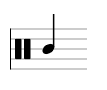
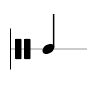
This clef is an absolute exception: It does not indicate pitch. It usually consists of two parallel vertical lines and is used for drums and percussion.
On five lines: The different lines and spaces here do not stand for notes like C or G, but for specific parts of the drum kit (e.g., bottom line = bass drum, third space from the bottom = snare drum).
On a single line: If only a single rhythm instrument without different pitches is notated (such as a triangle, claves, or a simple drum), a single line is completely sufficient. The note on the line then simply indicates the pure striking rhythm.
Free Online Exercises
Interactive carousel with 5 music theory exercises. Use the arrow keys or swipe to move between the exercises.
Note Trainer
Practice quickly identifying notes on the staff. Perfect for preparing for music exams.