The circle of fourths is actually just an overcomplication of the circle of fifths and only useful if you haven’t mastered the keyboard backward…
As we know, a circle of fifths shows us the key signatures of the various scales. To do this, starting from C, we always jump a fifth higher for the sharps. So it goes: C, G, D, etc., for the sharps (G major one sharp, D major two, etc.).
Normally, for the flats, we would start the whole thing ‘backward’ starting from C, i.e., always going down a fifth: C, F, Bb, etc. Now, with the circle of fourths, logically we jump up a fourth from C and arrive at the same result: C, F, Bb, etc…
So, with the so-called circle of fourths, we can calculate the flats by always jumping up a fourth instead of down a fifth. However, you only need this if you haven’t mastered the keyboard backward…
Actually, the circle of fourths is unnecessary and only overcomplicates the otherwise simple circle of fifths… By the way, the circle of fourths also works ‘backward’: for the sharps.
See also: The Circle of Fifths
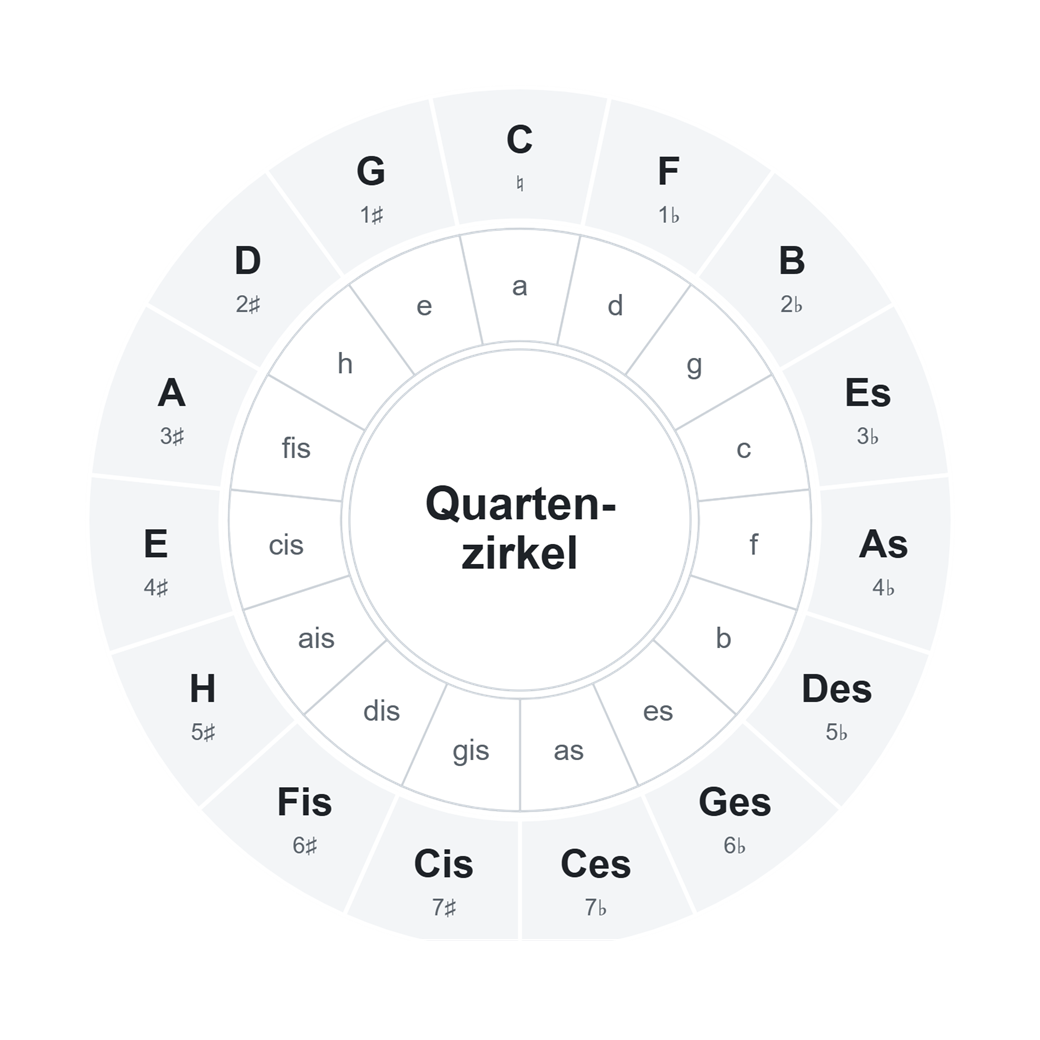
The circle of fourths displays all major and minor keys clockwise, ordered by fourths:
- C major (A minor): no accidentals
- F major (D minor): 1 ♭ (Bb)
- Bb major (G minor): 2 ♭ (Bb, Eb)
- Eb major (C minor): 3 ♭ (Bb, Eb, Ab)
- Ab major (F minor): 4 ♭ (Bb, Eb, Ab, Db)
- Db major (Bb minor): 5 ♭ (Bb, Eb, Ab, Db, Gb)
- Gb major (Eb minor): 6 ♭ (Bb, Eb, Ab, Db, Gb, Cb)
- Cb major (Ab minor): 7 ♭
- C# major (G# minor): 7 ♯
- F# major (D# minor): 6 ♯ (F#, C#, G#, D#, A#, E#)
- B major (A# minor): 5 ♯ (F#, C#, G#, D#, A#)
- E major (C# minor): 4 ♯ (F#, C#, G#, D#)
- A major (F# minor): 3 ♯ (F#, C#, G#)
- D major (B minor): 2 ♯ (F#, C#)
- G major (E minor): 1 ♯ (F#)
Every major key has a relative minor key with the same key signature.
Free Online Exercises
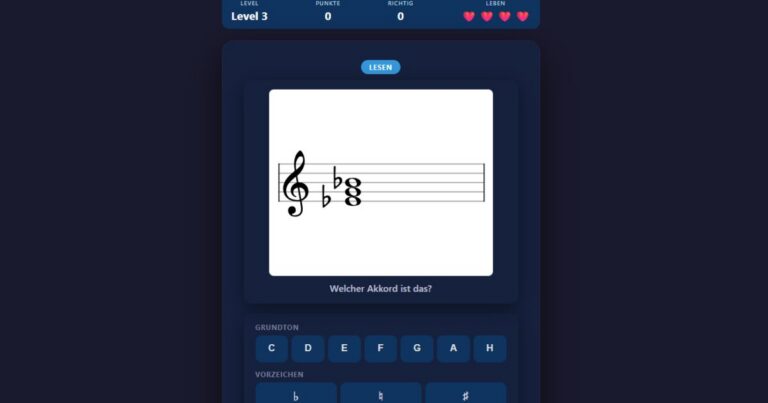
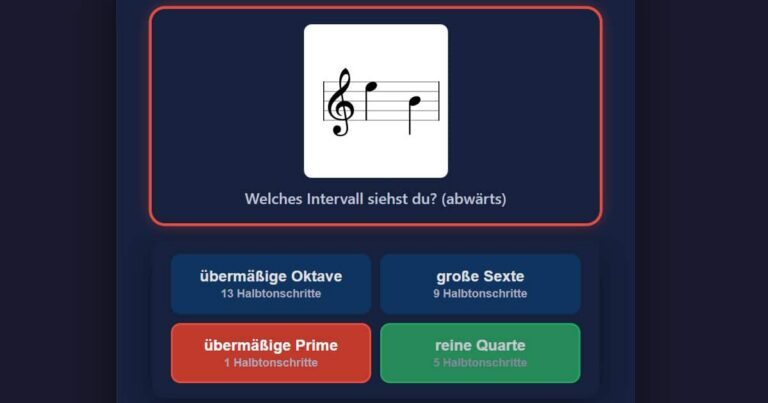
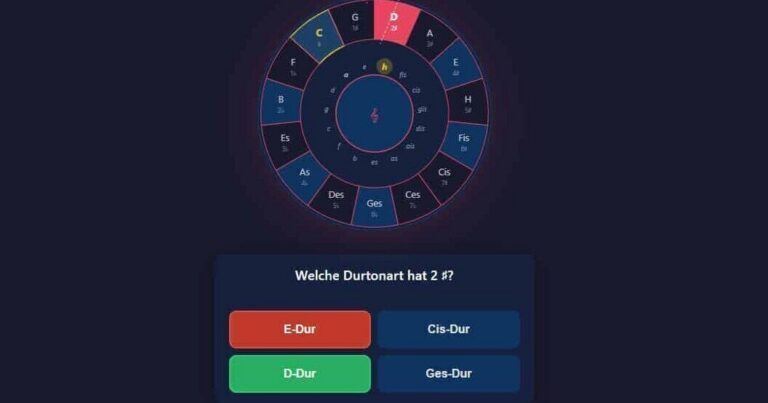
Interactive carousel with 5 music theory exercises. Use the arrow keys or swipe to move between the exercises.
Note Trainer
Practice quickly identifying notes on the staff. Perfect for preparing for music exams.